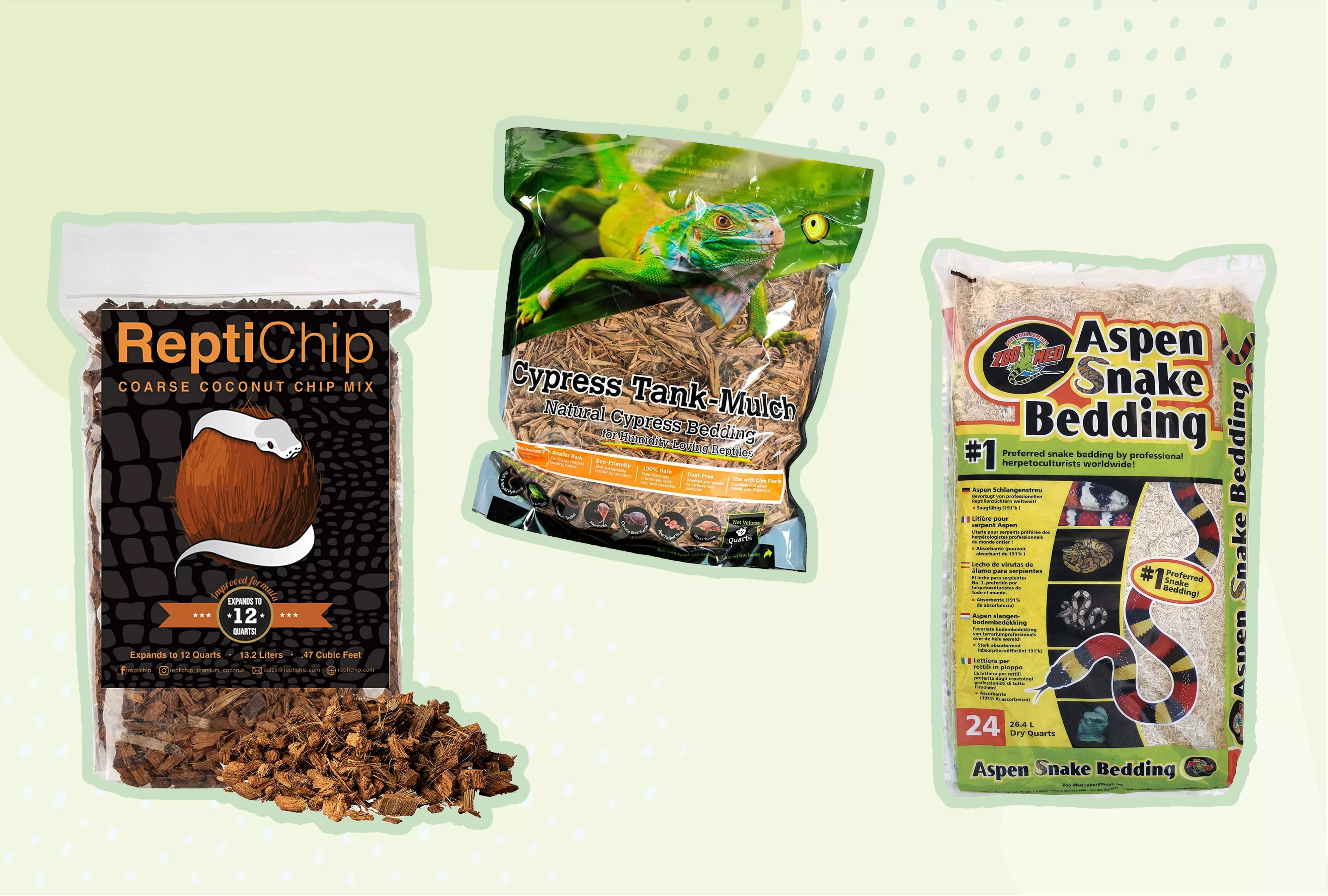
When selecting bedding for your snake, you'll want to consider how well the bedding absorbs urine and odors, how it insulates or maintains humidity, and whether it provides adequate coverage for burrowing snakes. Finding the right bedding will depend on the species of snake in your care, along with individual considerations like maintenance needs and aesthetic preferences.
"Look for something easy to clean, or replace quickly and easily," Dr. Lyle Cleary of the Center for Avian and Exotic Medicine in New York told The Spruce Pets. Dr. Cleary specializes in reptiles and exotic pets and contributed his advice and insights to our search for the best snake bedding.
He also keyed us in to what should be avoided: "Nothing that emits a smell when clean; nothing that is loose or able to be accidentally swallowed by snakes fed in the enclosure or on the substrate.”
Our top pick for an arid environment is Zoo Med Aspen Snake Bedding because it is affordable, absorbent, odorless, and dust-free.
Aspen bedding is useful for a wide range of pet snakes, thanks to its neutral odor and high absorption. It allows for burrowing, too. It’s especially good for corn snakes, hognose snakes, milk snakes, and other species that prefer drier environments and the ability to burrow. If you have a tropical snake that needs high humidity—such as a ball python—you’ll likely want a bedding that’s better at both retaining and releasing humidity, like cypress mulch.
Zoo Med Aspen Snake Bedding boasts 191 percent absorbency, and its wood shavings are undyed and virtually dust-free. The aspen from which it’s derived isn’t as oily as pine and cedar, so the bedding doesn’t carry residue or stickiness.
Zoo Med bedding is also one of the best picks for most snakes and snake owners because of its reliability. Founded in 1977, it’s a central brand in herpetology, and its products are used in zoos, aquariums, and conservation organizations around the world.
While Zoo Med’s aspen bedding is fantastic at absorbing liquids and containing odors, it’s important not to leave wet bedding in place, since it can encourage mold growth. In addition to regular cleanings, Zoo Med recommends fully replacing its bedding every two to three months.
Zoo Med Aspen Snake Bedding is available in a variety of sizes—a 24-quart bag of bedding is suitable for filling a 40-gallon tank.
Sizes: 4-, 8-, 24-quart bag
ReptiChip washes its Coarse Coconut Chip Mix three times, eliminating agitating impurities such as salt and thoroughly rinsing the staining tannins from its blend of coconut husk chips. Coconut fibers are very good at retaining moisture and can be soaked in water for high-humidity snake species. Coconut is also excellent at capturing odors.
ReptiChip sells a variety of coconut fiber chips for reptile bedding, ranging from small chips suitable for hatchlings to larger, more coarse varieties ready-made for pythons and boas. It also offers a compacted Breeder Block if you're looking to fill large or multiple enclosures, though you have to first soak it to rehydrate and expand the block.
Sizes: 12-, 36-quart bag
Cypress mulch is excellent at retaining moisture, making it (or similar substrates) an essential part of providing a humid environment for tropical or semi-tropical snake species. Mulch is especially good for burrowing species since its light and loose pieces can be easily shifted. Made from timber byproduct, Galapagos Cypress Tank Mulch is washed and sieved to be dust-free.
Galapagos’ Tank Mulch Cypress Bedding comes in resealable bags, so it's especially useful for smaller terrariums that may not go through substrate as fast.
Sizes: 8-, 24-quart bag
Fluker’s Repta-Bark Forest Floor Substrate uses orchid bark, named because it’s often used for orchid growing, though it’s typically made from fir tree bark. While similar to cypress mulch in its ability to retain humidity for tropical species, this bark is composed of big, rounder pieces, more like chips. This can make it a little less appealing to burrowers, but also creates a denser, more uniform floor to your snake’s habitat, which can be better for snakes that eat crickets and other live feeder animals.
Fluker’s Repta-Bark is our favorite alternative to Galapagos Tank Mulch, especially because of its rich, uniform color. It’s also available in multiple sizes.
Sizes: 4-, 8-, 24-quart bag
The 27 Best Aquarium Decorations to Brighten Up Your Fishes’ Home
If you like the simplicity of paper but want something a little more attractive, then Zilla Terrarium Liner is an excellent alternative. Rather than pouring in the bedding by volume, you can cut Zilla liners to fit the exact footprint of your terrarium. The liners come in a variety of sizes, so you can get the closest match right out of the box.
A carpet liner has several advantages over bedding. Most importantly, it can't be ingested, making it a good pick for anyone with a young reptile that is not well-acclimated to eating around bedding. It's also highly reusable: Simply pull out soiled bedding, rinse it under cold water, and allow it to air-dry before replacing it in your snake's habitat.
However, this comes at the cost of absorbency. While Zilla Terrarium Liner can absorb quite a bit of liquid, it's not going to hide and contain solid waste as well as wood shavings or other types of bedding. Plus, while the Zilla floor liner can be spot-cleaned, you’ll occasionally need to take out the whole carpet to clean it. It can be advantageous to have two liners cut to size, so while one is being washed and air-dried, the other can be installed.
The Zilla Terrarium Liner is available in brown and green.
Sizes: 8 options, from 9.75 x 19.75 inches to 17.25 x 71 inches
Galapagos Terrarium Green Sphagnum Moss is washed and cleaned before it's packaged, so it can be placed right away in your snake's habitat.
The sustainably sourced green sphagnum moss makes great bedding for a variety of snakes. The all-natural moss retains and releases moisture to provide a humid and moist habitat that helps keep snakes hydrated and comfortable. Many snakes, along with other reptilian species, enjoy hiding in this moss. It likely appeals to their instinctive survival method of hiding from predators.
This moss from Galapagos Terrarium only comes in one size, and depending on your needs, you might find it is one of the more expensive options on our list.
Sizes: 4-quart bag
Terra Firma Reptile Substrate from Bio Dude provides a natural-feeling environment that helps many snakes thrive. The dirt-like substate retains moisture, making it ideal for tunneling and burrowing, which is also beneficial for the natural shedding process.
This substrate is packaged in 36-quart-sized bags that are easy to open but not resealable. Once the bag is opened, we recommend using as much as possible in your snake's habitat and storing the rest in a resealable bag or container to keep the substrate from gathering additional moisture. You can also use the substrate to decorate with fake or real plants in your snake's home.
Sizes: 36-quart bag
Eco Coconut Fiber Substrate is another choice from the respected brand Zoo Med. It is a sustainable option popular among Amazon shoppers, with an average rating of 4.7 stars. The loose coconut fibers excel at humidity retention, which makes them ideal for ball pythons. The soft texture also supports snakes' natural digging behavior.
This substrate has little to no smell and is highly effective at absorbing and breaking down odors and waste. Although the loose texture makes it fairly easy to spread around a tank—you don't have to break up a compressed brick—it can get a bit dusty and messy to clean up. One user suggests wearing a mask while cleaning, as "it does stick to [your] nostrils," while another says "spraying it with water helps keep it together."
There is also a low risk of impaction, since the natural coconut fibers are safely digestible. Several users have reported no adverse reactions when their pets ingested small amounts of the substrate.
Sizes: 8-, 12-quart bag
Final Verdict Zoo Med Aspen Snake Bedding is a favorite among snake owners for its affordable, dust-free, odor-eating dependability. If you’re the owner of a tropical snake, we recommend ReptiChip Coconut Chip Bedding. This coconut chip bedding comes either loose or in a compressed brick, is organic, and is washed three times to remove impurities. It is good at maintaining moisture and can be soaked to maintain high humidity.
Final Verdict
Zoo Med Aspen Snake Bedding is a favorite among snake owners for its affordable, dust-free, odor-eating dependability. If you’re the owner of a tropical snake, we recommend ReptiChip Coconut Chip Bedding. This coconut chip bedding comes either loose or in a compressed brick, is organic, and is washed three times to remove impurities. It is good at maintaining moisture and can be soaked to maintain high humidity.
What to Look For in a Snake Bedding Option
Type of Bedding
Wood Shavings: Small, uniform pieces with high absorbency. Our favorite is aspen wood, which doesn’t have oils that can irritate snakes. While excellent for handling messes—and easy to scoop for spot cleaning—this type of bedding isn’t meant to retain moisture for high humidity and tropical species.
Mulch: While mulch can come in a wide range of materials, when referring to snake bedding, it generally indicates varied small pieces of fir tree wood, including hunks of bark and interior wood. If you’re looking for a clean aesthetic, this probably isn’t it, but mulch has a lot of advantages for snakes that need humidity and love to burrow.
Bark: Typically, more uniform and larger pieces than mulch. Bark can be used to create a denser floor layer, which is good for species that hunt live prey in their habitat, or would prefer more usable space for sunning than for hiding.
Coconut: Coconut husk replicates many of the advantages of mulch and bark, and is more absorbent than either, making coconut beddings a good pick for tropical species.
Paper and Fabric Liners: These types of liners lie flat and don’t provide depth for your snake to hide or burrow in. While paper is easy to replace, it doesn’t lock moisture away from your snake’s skin, and so requires frequent changing. Fabric liners can add some absorbency and padding, but are a little trickier to wash.
Preparation
While snake bedding materials are typically washed, and sometimes even baked, there’s always the possibility of mites or other small insects coming along for the ride. We’ve picked products from well-established reptile brands with consistent quality control, but a few cautionary preparatory steps can’t hurt, just in case.
For additional guidance regarding snake care, we spoke with Dr. Beth Bystrom of Sea Island Animal Hospital in Beaufort, South Carolina, who recommended freezing natural substrates overnight prior to use. That will kill off any mites, and then you can feel confident adding the new substrate to your terrarium.
Why Trust The Spruce Pets?
This roundup was written by Ellie Welles, a product researcher and writer for The Spruce Pets. A specialist in small pets, Ellie spoke with a variety of sources and utilized experts in small animal care to assemble the best guinea pig supplies, ferret toys, and chinchilla cages. Her two cats were a little more helpful when it came to finding great window perches.
A previous version of this article was written by Adrienne Kruzer, a registered and licensed veterinary technician in three states who has been writing on pet and vet topics for over a decade. She is also Fear Free Certified, has a special interest in exotic and pocket pets and pet nutrition, and loves researching, learning, and problem-solving to better help pet owners. Her years of working in various animal hospitals with dogs, cats, wildlife, and exotic pets like snakes, alongside her formal college education and elective continuing education classes, have provided her with a wealth of experience and knowledge to help snake owners select the best bedding for their pets.
Dr. Beth Bystrom is a veterinarian at Sea Island Animal Hospital in Beaufort, South Carolina. She enjoys treating dogs, cats, and exotic pets, including snakes, and has also earned her certificate for small animal abdominal ultrasound and echocardiology to continue her education. She has a passion for all things scaly, feathery, and furry and loves helping pet owners care for their pets.
Also consulted for this article was Dr. Lyle Clear, a veterinarian at the Center for Avian and Exotic Medicine in New York.
The 11 Best Bearded Dragon Supplies, According to a Veterinarian